Sweet Sorghum
 |
Historical: Maasdam Sorghum Mills
|
My mother grew up in the 1920s on a farm in the Urbana - Center Point area (Iowa). She recalled only having sorghum (sometimes she referred to the syrup as molasses)* to sweeten her morning oatmeal. Sorghum was also the syrup the family used on pancakes and waffles. When she tired of eating pancakes with sorghum, day-after-day, she would open a jar of canned peaches and eat peaches on the pancake, or perhaps applesauce. But most often her morning breakfast would include sorghum. Sweet sorghum syrup was commonly referred to as sorghum molasses or just plain molasses, although molasses is actually a byproduct of sugar cane or sugar beets. After World War II, sorghum production dropped significantly, as raising and harvesting sorghum, for syrup, was very labor intensive. Now less than 1 million gallons of syrup are produced annually in the United States -- most of it in seven states in addition to Iowa (Alabama, Arkansas, Georgia, Kentucky, Mississippi, North Carolina, and Tennessee). One of the only surviving sorghum mills in Iowa, the Maasdam Sorghum Mills, 6495 E. 132nd
St. S., Lynnville, Iowa 50153, began operation in 1926. I've never been to their mill but the process and history is the subject of a video at
https://youtu.be/hV6ztHccDy0.
In later decades, well after the 1920s, when my siblings and I were growing up on an Iowa farm, there was not a crop of sorghum plants - and despite the fact that my mother had tired of sorghum in her own childhood, commercially available molasses was often used for baking in her household. We most often used Brer Rabbit Molasses. We had two favorite recipes: Applesauce Molasses Cake and Molasses
Cookies. The original recipes came from a little recipe booklet
distributed by the Brer Rabbit company. These have been adapted over
the years.
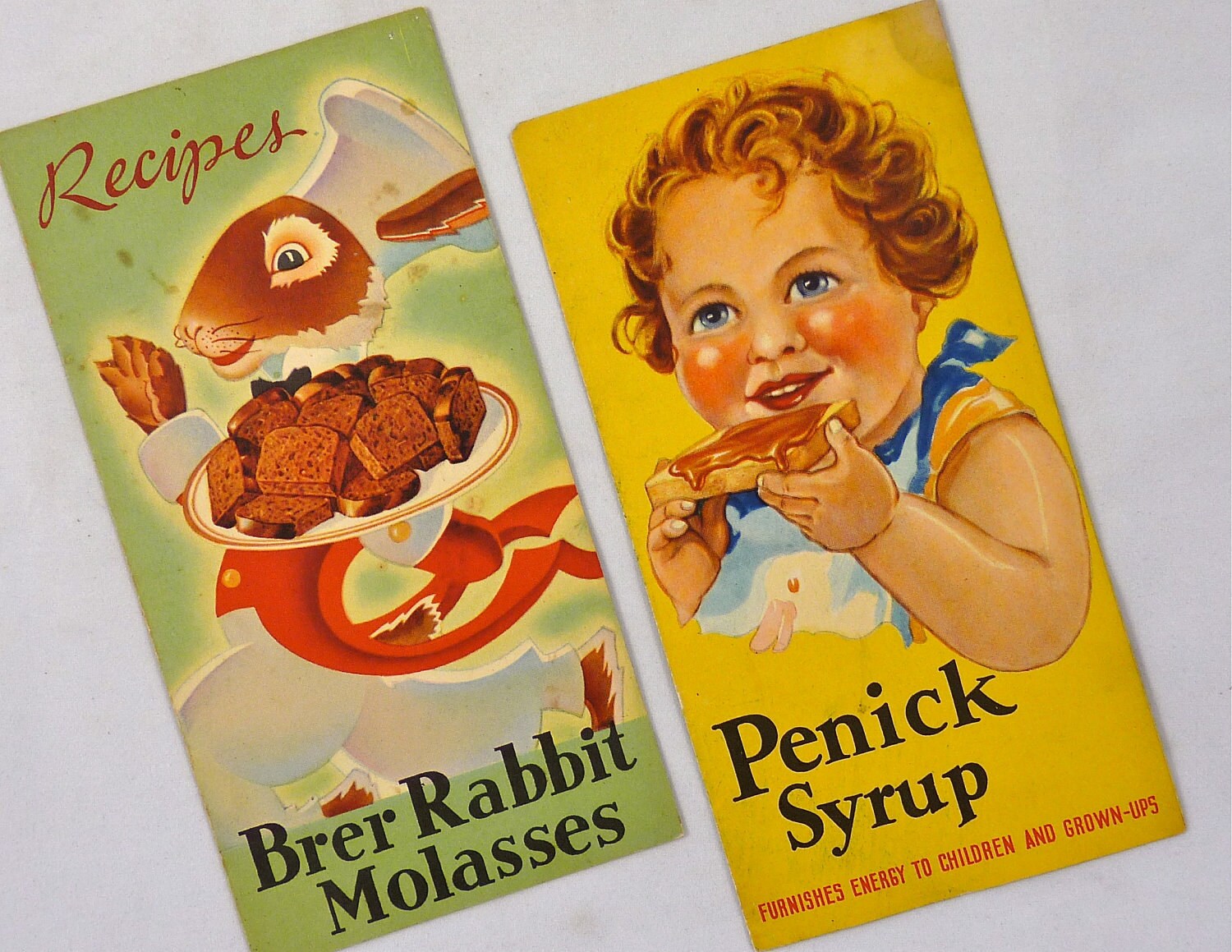
Most people associate Brer Rabbit Molasses with New Orleans, but these vintage company brochures (and the Brer Rabbit Penick Waffle and Pancake Syrup) establishes the connection between Brer Rabbit Molasses (and Penick Syrup) with Iowa. Penick and Ford Ltd established a plant in Cedar Rapids Iowa, built on the remains of the Douglas Starch works plant that had been rocked by an explosion in 1919.
*Molasses vs. Sorghum
The
sorghum plant, a
type of
grass, was introduced into the
United States
from
Africa in the
early part of the 17th century. Sorghum syrup is a natural sweetener made by processing the
juice
that is extracted from the sorghum plant. Special equipment is used to crush and extract the juice. Farmers sent the sorghum stalks to mills for the extraction. Sorghum syrup is produced primarily in the
United States and is used as a substitute
for sugar. It tends to have
a thinner consistency and a
slightly more sour taste than does molasses
 Molasses was also introduced to the
United States during the
17th century when
traders started transporting it from the
Caribbean to New England where it was popular as an ingredient for rum. Molasses was the
most popular sweetener
until the late
19th century because it was more affordable than sugar. Molasses is the by-product of
processing sugar
cane into sugar. The
sugar cane
plant is stripped of
its leaves and the juice
is extracted from the cane by crushing or mashing. The juice is boiled to concentrate it,
which produces crystallization of
the
sugar. The
result of the first boiling and removal of the sugar
crystals is called “first molasses” (mild)
and is the sweetest tasting. “Second
molasses” (dark) is created from a
second boiling and removal of sugar crystals. “Blackstrap” is the
result of
a third boiling of the syrup. The
darker molasses is
considered bittersweet.
Molasses was also introduced to the
United States during the
17th century when
traders started transporting it from the
Caribbean to New England where it was popular as an ingredient for rum. Molasses was the
most popular sweetener
until the late
19th century because it was more affordable than sugar. Molasses is the by-product of
processing sugar
cane into sugar. The
sugar cane
plant is stripped of
its leaves and the juice
is extracted from the cane by crushing or mashing. The juice is boiled to concentrate it,
which produces crystallization of
the
sugar. The
result of the first boiling and removal of the sugar
crystals is called “first molasses” (mild)
and is the sweetest tasting. “Second
molasses” (dark) is created from a
second boiling and removal of sugar crystals. “Blackstrap” is the
result of
a third boiling of the syrup. The
darker molasses is
considered bittersweet.
The history of the Penick and Ford Plant in Cedar Rapids Iowa is detailed on the
company's official site.
The company is now the Penford Corporation.
- 1903: The Douglas brothers form Douglas Starch Works in Cedar Rapids, Iowa.
- 1919: Douglas Starch Works is sold to Penick & Ford, Ltd.
 1965: Penick & Ford is purchased by R.J. Reynolds Tobacco Company.
 - 1971: R.J. Reynolds sells Penick & Ford to the Univar Corporation.
- 1984: Penick & Ford and Great Western Malting, set up as divisions of Penwest Ltd., are spun off from Univar.
- 1989: Great Western is divested.
- 1997: The company changes its name to Penford Corporation.
- 1998: Penwest Pharmaceuticals Co. is divested.
- 2002: Penford relocates headquarters to Denver, Colorado.

Penford's present-day facility produces ethanol and corn syrup and maintains a large facility in downtown Cedar Rapids, Iowa.


 Molasses was also introduced to the
United States during the
17th century when
traders started transporting it from the
Caribbean to New England where it was popular as an ingredient for rum. Molasses was the
most popular sweetener
until the late
19th century because it was more affordable than sugar. Molasses is the by-product of
processing sugar
cane into sugar. The
sugar cane
plant is stripped of
its leaves and the juice
is extracted from the cane by crushing or mashing. The juice is boiled to concentrate it,
which produces crystallization of
the
sugar. The
result of the first boiling and removal of the sugar
crystals is called “first molasses” (mild)
and is the sweetest tasting. “Second
molasses” (dark) is created from a
second boiling and removal of sugar crystals. “Blackstrap” is the
result of
a third boiling of the syrup. The
darker molasses is
considered bittersweet.
Molasses was also introduced to the
United States during the
17th century when
traders started transporting it from the
Caribbean to New England where it was popular as an ingredient for rum. Molasses was the
most popular sweetener
until the late
19th century because it was more affordable than sugar. Molasses is the by-product of
processing sugar
cane into sugar. The
sugar cane
plant is stripped of
its leaves and the juice
is extracted from the cane by crushing or mashing. The juice is boiled to concentrate it,
which produces crystallization of
the
sugar. The
result of the first boiling and removal of the sugar
crystals is called “first molasses” (mild)
and is the sweetest tasting. “Second
molasses” (dark) is created from a
second boiling and removal of sugar crystals. “Blackstrap” is the
result of
a third boiling of the syrup. The
darker molasses is
considered bittersweet.
 1965: Penick & Ford is purchased by R.J. Reynolds Tobacco Company.
  Penford's present-day facility produces ethanol and corn syrup and maintains a large facility in downtown Cedar Rapids, Iowa.